PA6-CF vs PA6-GF is one of the most common comparisons when choosing a stiffer PA6-based 3D printing engineering material intended for functional parts. PA6-based composite 3D printing materials are increasingly used not only for prototyping, but also for real functional parts that must maintain shape, stiffness, and mechanical integrity. Among the most commonly compared variants, two directions stand out – PA6-CF and PA6-GF. In the first case, the PA6 matrix is reinforced with carbon fiber, in the second – with glass fiber. Both solutions are intended for technical parts, but their characteristics and practical application differ.
PA6-CF material is a high-class, very stiff and mechanically strong material intended for parts that must remain stable under higher loads, elevated temperature, and long-term mechanical stress. Meanwhile, PA6-GF material is a PA6-based composite material with glass fiber, whose purpose is to strengthen the polyamide matrix and reduce deformation risk during and after 3D printing.
PA6-CF is a PA6-based composite material with carbon fiber filler. In the case of PA6-CF25, the carbon fiber content reaches 25%, and the main emphasis is high stiffness, heat resistance, dimensional stability, and suitability for functional, industrial parts. Depending on the manufacturer and application, PA6-CF materials are available with different carbon fiber content, typically ranging from 10% to 25%.
PA6-GF is a PA6-based composite material with glass fiber filler. In PA6-GF15, 15% glass fiber is used, which increases stiffness and helps reduce deformation risk. This shows that this direction is oriented toward a stronger and more stable PA6 version, where not only strength is important, but also controlled behavior during the printing process. Similarly, PA6-GF materials on the market are available with varying glass fiber content, commonly ranging from 10% to 25%, depending on the intended use and performance requirements.
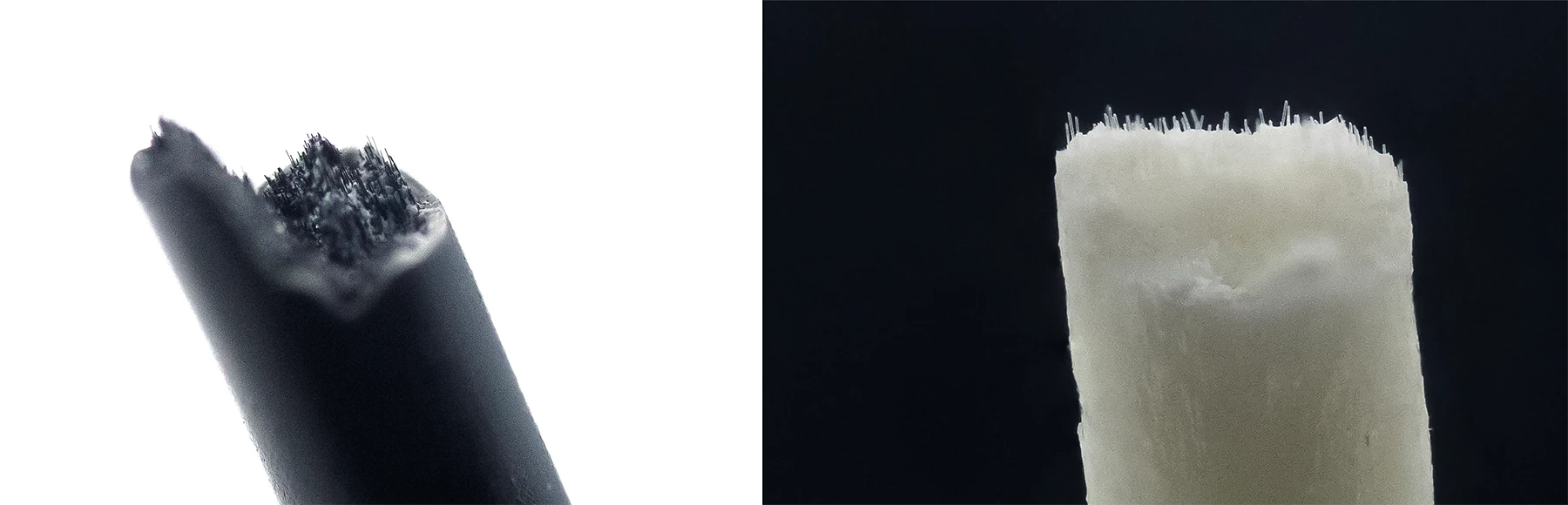
Macro photos of PA6-CF25 and PA6-GF15 engineering filament cross-sections. On the left, PA6-CF25 material with carbon fiber reinforcement is visible, on the right – PA6-GF15 with glass fiber reinforcement. The images clearly show that both materials are based on the same PA6 matrix, but differ in the type of reinforcing filler used and the resulting material behavior.
When comparing these two materials from a technical perspective, PA6-CF material is more associated with stiffness, structural stability, and higher resistance to heat. PA6-GF material, on the other hand, emphasizes reinforcement of PA6 with glass fiber and reduction of deformation risk. In other words, one material emphasizes stiffness and higher-class structural behavior, while the other represents a reinforced and practically more stable version of PA6.
PA6-based 3D printing materials are strongly hygroscopic, meaning they actively absorb moisture from the environment. Since both PA6-CF and PA6-GF are based on PA6, proper drying of the material before printing is very important in both cases. This is directly related to a more stable process, cleaner surface, and more predictable mechanical properties.
Moisture can worsen print quality, cause bubbling during extrusion, weaken layer adhesion, and affect dimensional stability. Therefore, good mechanical properties alone are not enough – it is also important how the material is prepared before printing and how it is handled afterward.
PA6-CF material is more suitable in cases where the part must maintain stiffness, shape, and dimensional stability under higher load or elevated temperature. PA6-CF is often chosen for brackets, joints, housings, and other functional parts where stiffness and long-term stability are important.
PA6-GF material is chosen when a reinforced PA6 material with higher stiffness and lower deformation risk is needed, but the selection itself is oriented toward a practical, technically stable result. PA6-GF can be considered a very rational choice when the goal is to go beyond standard PA6, but the main objective is more stable and predictable composite behavior.
| Property | PA6-CF | PA6-GF |
|---|---|---|
| Filler | Carbon fiber. | Glass fiber. |
| Compared variant | PA6-CF25 with 25% carbon fiber. | PA6-GF15 with 15% glass fiber. |
| Main focus | High stiffness, dimensional stability, and heat resistance. | Reinforcement of PA6 and lower deformation risk. |
| Material character | More structural, oriented toward a rigid and technically demanding part. | More balanced, oriented toward a more stable practical result. |
| Most suitable parts | Brackets, joints, housings, structural elements. | Functional technical parts where strength and lower deformation are important. |
| Moisture sensitivity | High. Drying before printing is necessary. | High, because the base is PA6. In practice, drying is also important. |
| When to choose | When stiffness and stability are the priority. | When reinforced PA6 and lower deformation risk are the priority. |

Both of these 3D printing materials belong to a technically more demanding class, therefore not only proper drying is important, but also a stable temperature regime, an abrasion-resistant nozzle, and a stable printing environment.
In practice, even a good material will not show its potential if it is printed while moist or under unstable conditions. The most important points in practice are:
| Situation | What to choose more often | Why |
|---|---|---|
| Structural brackets and fastening elements. | PA6-CF. | Greater emphasis on stiffness, shape, and dimensional stability. |
| Parts operating at elevated temperatures. | PA6-CF. | Higher heat resistance and more stable behavior under demanding conditions. |
| Functional parts where reducing deformation risk is important. | PA6-GF. | Increases stiffness and helps reduce deformation risk. |
| Technical PA6 parts where more stable behavior than standard PA6 is required. | PA6-GF. | Glass fiber reinforces the PA6 matrix and helps achieve a more technically robust result. |
| Parts where print quality and a predictable result are important. | Both, but only with properly dried material. | Drying is directly related to surface quality, layer adhesion, and mechanical properties. |
PA6-CF vs PA6-GF are not simply two similar names. These are two different directions of PA6 composites. PA6-CF material is more oriented toward high stiffness, heat resistance, and dimensional stability, while PA6-GF material is a reinforced PA6 version with glass fiber, whose goal is also to help reduce deformation risk. In both cases, drying is very important, because PA6-based materials are sensitive to moisture, and this directly affects the final result.
9:00 – 18:00 val. darbo dienomis
Savaitgaliais – Dažniausiai dirbame
Turite klausimų, o gal reikalinga konsultacija apie 3D spausdinimo technologijas ir gamybą? Susisiekite!
Visada laukiame lankytojų – tik iš anksto suderinus!
© 2026 WRYEDGE | Visos teisės saugomos