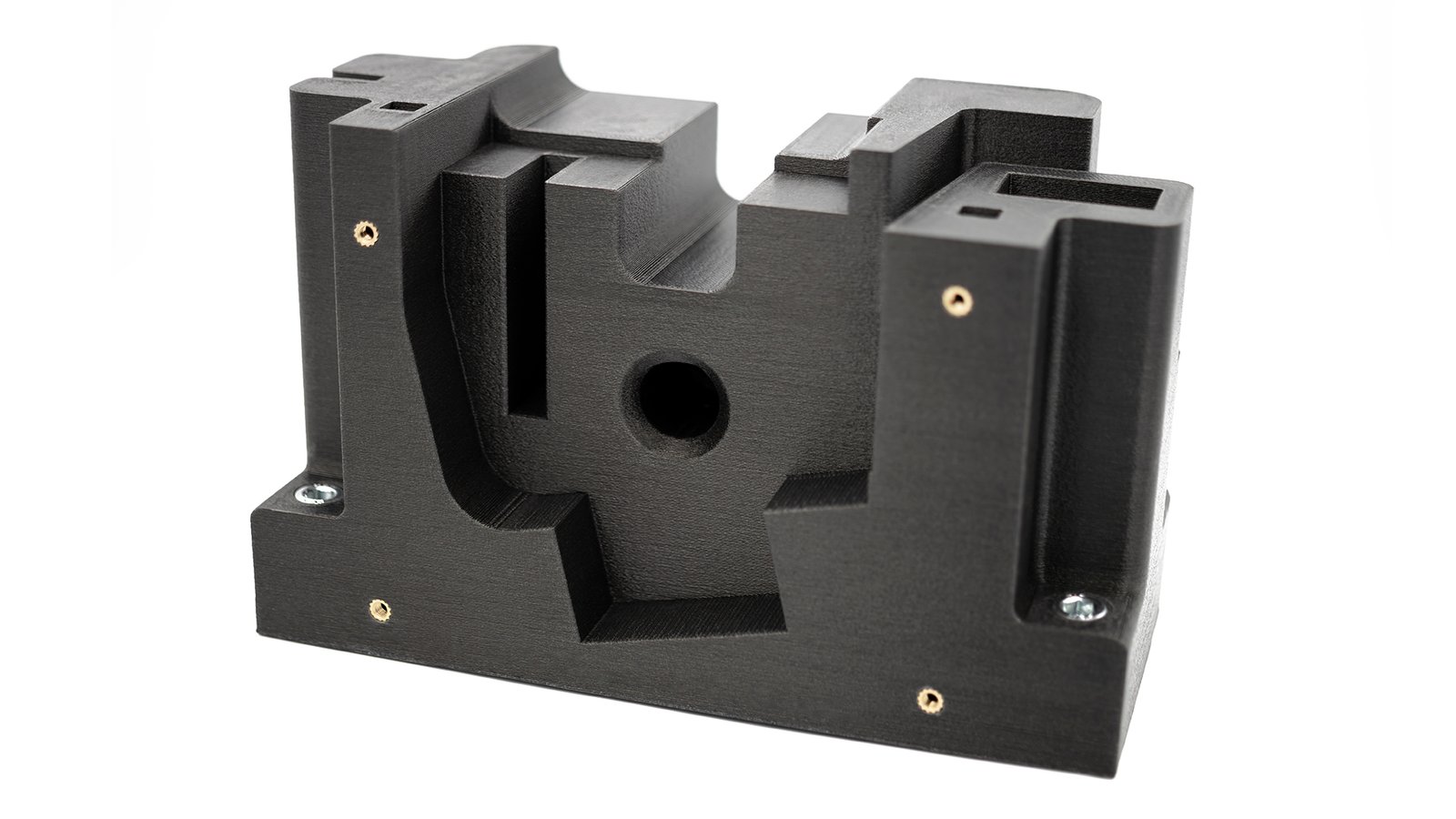
ABS-CF20 is a modern advanced engineering thermoplastic with composite properties. This material is based on virgin ABS (acrylonitrile butadiene styrene) raw material, reinforced with 20% chopped carbon fibre particles. As a result, it offers significantly increased stiffness, lower weight, improved heat resistance, and a reduced coefficient of thermal expansion compared with conventional ABS materials used in 3D printing.
This material is produced using a dual-core extrusion process, where the material strand receives a two-layer structure: the outer ABS layer ensures good adhesion between layers and a smoother surface, while the inner layer — ABS reinforced with carbon fibre — provides mechanical strength and improved thermal stability. In simple terms, this material combination improves stiffness and thermal stability both in the XY and Z directions.
Assembly line tool. 3D printing technology: FDM | Material: ABS-CF20 | Dimensions: 200 × 100 × 120 mm. (WRYEDGE photo)
Because of these properties, ABS-CF20 is well suited for prototypes requiring better mechanical performance, functional parts, and industrial mounting systems where dimensional stability, strength, and reliable 3D printing results are important.
ABS-CF20 is a composite material made from ABS polymer reinforced with carbon fibre particles. The manufacturing process consists of several important stages, each of which affects the final material properties — from fibre preparation to dual-core extrusion.
The carbon fibre used in this two-component material is usually pre-chopped into very small particles. Their length typically ranges from 100–300 µm, while the diameter is usually around 5–7 µm. This particle size is selected intentionally to maintain a balance between suitable mechanical properties and stable 3D printing through the printer nozzle. Longer carbon fibre particles can provide better mechanical properties to printed parts, but they also increase the complexity of the printing process and can accelerate equipment wear.
Carbon fibre particles are mixed with ABS granules using a special twin-screw extruder, through a process known as plastic compounding. During this process, the carbon fibre particles are evenly distributed within the ABS matrix. Dispersing agents and other additives may also be used to improve bonding between the carbon fibre particles and the ABS structure, increasing the uniformity of the final material.
The homogenised mixture is fed into a dual-core extrusion, or co-extrusion, system where two separate material flows are used: one is pure ABS for the outer skin layer, and the other is ABS reinforced with carbon fibre for the inner core layer.
This creates a two-layer material strand, where the outer surface is smoother and easier to print, while the inner structure provides additional mechanical strength. The final material diameter is calibrated to 1.75 mm or 2.85 mm, while the processing temperature usually ranges around 260 °C, depending on the specific ABS formulation and carbon fibre concentration. After cooling, the material strand is wound onto familiar 3D printing spools.
Oriented carbon fibre particles inside ABS-CF20 material. (WRYEDGE photo)
This macro photograph clearly shows the cross-section of ABS-CF20 (ABS with 20% carbon fibre) material and its internal composite structure. Fine, directionally distributed carbon fibre particles are clearly visible — these are the main reinforcing component of this material. It is also evident that the fibre is well integrated into the ABS matrix, which indicates proper homogenisation during material production.
An important factor is the orientation of carbon fibre particles during printing. Due to the compounding process, when carbon fibre is mixed with ABS, the particles usually tend to align in the extrusion direction.
ABS-CF20 is an engineering-grade material, so printing with it requires slightly more experience and properly selected 3D printer parameters. Due to the carbon fibre particles in its composition, the material becomes stiffer and more resistant to heat, but it also contains abrasive particles that can wear down printer components, especially the nozzle.
| Parameter | Value / Notes |
|---|---|
| Nozzle temperature | 250–270 °C |
| Heated bed temperature | 100–110 °C |
| Nozzle size / material | 0.4–1.0 mm | tool steel, HRC 60–65 |
| Build plate surface | PEI or PVP glue layer |
| 3D printing speed | 30–120 mm/s (optimal: 50 mm/s) |
| Model infill density | Optional | 90% (used in tests) |
| Infill angle | ±45° |
| Raft separation distance | 0.18–0.20 mm |
| Retraction distance | 1–3 mm |
| Retraction speed | 1800–3600 mm/min |
| Material drying before printing | Recommended 60–70 °C, 4–6 h |
| Support material | HIPS | Modified HIPS (recommended) |
The surface of ABS-CF20 material has a slightly more pronounced layered structure than standard printed ABS. This structure forms during the FDM 3D printing process. Each printed layer becomes more visible due to the increased surface roughness caused by the carbon fibre particles. In a magnified image fragment, micro-ripples between layers can be seen — this is a typical layering effect caused by changes in the print head direction or minor extruder vibrations.
This texture also acts as a visual indicator of layer bonding quality. The smaller and more consistent the gaps between layers, the better the mechanical uniformity of the printed part.
Layer arrangement of ABS-CF20 material. (WRYEDGE photo)
Carbon fibre is the main factor contributing to the surface texture irregularity, but at the same time it adds functional value — better adhesion to adhesives and paints, as well as a tougher external structure with improved impact resistance.
The direction of the printed layers is also very important. In the case of ABS-CF20, due to the orientation of carbon fibre particles in the XY plane, the mechanical properties of printed parts are strongest in the horizontal direction. In the Z direction, meaning between layers, strength depends on the effectiveness of interlayer bonding and on the remaining, more chaotically distributed carbon fibre particles.
A well-calibrated print profile, optimal extruder temperature, and properly dried material help achieve a more uniform structure and reduce the risk of delamination.
This is important when preparing parts for 3D printing where anisotropy matters — in other words, when properties differ depending on the direction. For example, load-bearing brackets or structural elements should be oriented so that the main load direction corresponds to the strongest axis of the printed part, usually the XY plane.
Like many amorphous thermoplastics, ABS-CF20 is moderately hygroscopic, meaning it can absorb moisture from the surrounding environment, especially in high air humidity. This effect becomes more noticeable because of the 20% chopped carbon fibre particles in the material, which increase the overall surface area and can act as microscopic moisture accumulation points. This leads to faster moisture absorption into the material structure.
Although ABS is not as strongly hygroscopic as, for example, nylon or PC, the added carbon fibre and higher material density can still have a noticeable effect on print quality:
For this reason, ABS-CF20 must be dried before printing. The recommended drying temperature is 60–70 °C for 4–6 hours, using dedicated filament dryers or climate-controlled chambers with accurate temperature control. Properly dried material not only improves print quality but also extends nozzle service life by reducing abrasive effects during printing.
ABS-CF20 is not a basic material, so it can only be printed reliably with a properly prepared and suitable 3D printer. It is important that the printer meets several key requirements:
Carbon fibre reinforced ABS is usually intended for engineering applications. This material is well suited when slightly higher strength, dimensional stability, reduced part weight, and sufficient heat resistance are required.
| Well suited for | Not recommended for |
|---|---|
|
✅ Functional parts and prototypes.
✅ Non-critical drone / robotics components.
✅ Parts requiring heat resistance up to approx. 90 °C.
✅ Mounting systems and technical holders.
✅ Small and medium mechanical load-bearing components.
|
✕ Aesthetic models with very smooth surfaces.
✕ Very small or highly detailed objects.
✕ Flexible or elastic components.
✕ Contact with food or medical applications.
✕ Larger mechanically loaded objects.
|

ABS-CF20 is a modern composite material that combines the reliability of ABS with the stiffness of carbon fibre. Due to its mechanical properties, stability, and slightly higher heat resistance, this material is suitable for functional, higher-load parts and prototypes.
Although it is not ideal for aesthetic or very fine-detail parts, ABS-CF20 is a strong choice where greater rigidity, lower weight, reasonably good accuracy, and reliable performance are required.
9:00 – 18:00 on workdays.
Weekends – available upon request.
Do you have questions, or need a consultation about 3D printing technologies and production? Order form!
We are always happy to welcome visitors — just arrange your visit in advance. During your visit, you can explore our equipment, materials, and real production processes.
© 2026 WRYEDGE | All right reserved